Pastéis de nata
Pastéis de nata — Portuguese custard tarts with a flaky pastry shell and vanilla custard filling. For the home version, use ready-made butter puff pastry: roll it into a log, cut it into rounds, and stretch them in the molds while preserving the visible layers.
Additional 40 min — resting and preparation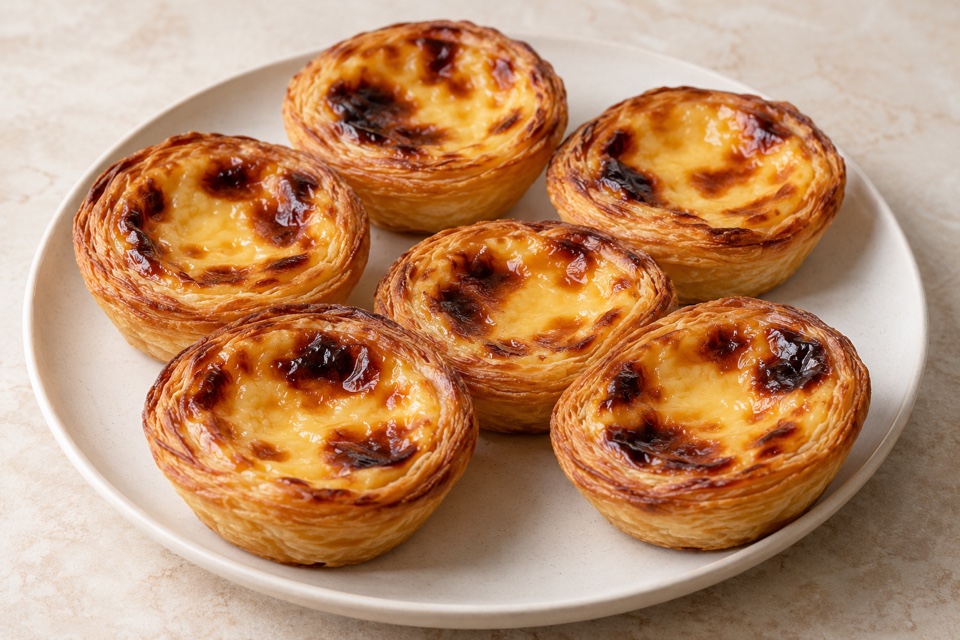
How to make it
Prepared 0 of 6 steps
Prepare the molds and dough
Lightly butter 12 metal tart moulds, each holding about 100 ml. Roll the cold pastry into a rectangle, then roll up tightly from a long edge. Cut into 12 equal rounds, keeping the spiral of layers visible.
Form the baskets
Place each round cut-side down in a mould. Using damp fingers, press the centre and gradually stretch the pastry up the sides into a thin, even shell. Do not tear the base. Refrigerate the lined moulds while you make the custard.
Boil the aromatic syrup
Combine the sugar, water, cinnamon stick and lemon zest in a small saucepan. Bring to the boil and boil for 2 minutes without vigorous stirring. Remove from the heat, discard the cinnamon and zest, and cool slightly.
Cook the milk base
Sift flour into 100 ml of cold milk and mix until smooth. Heat the remaining 250 ml of milk almost to a boil, then pour in the flour mixture and cook for 2 minutes with continuous stirring. Gradually stir in the syrup and cool to warm.
Add the yolks and bake
Stir the yolks and vanilla into the warm, not hot, milk mixture and strain through a sieve. Fill the pastry cases about two-thirds full. Bake in a fully heated oven at 250 °C for 18–23 minutes, until the pastry browns and the custard has characteristic dark spots.
Cool before serving
Leave in the molds for 10 minutes, then carefully transfer to a rack. The custard should set but remain tender inside. Serve warm or cold; any leftovers cool and refrigerate. Powdered sugar and ground cinnamon are not included in this version.
Little hint
Add the yolks only after cooling the milk base to warm temperature, otherwise curds will form. Use metal molds and a well-heated oven: thick silicone does not give as crisp a flaky shell.
Frequently asked questions
What should I watch out for when cooking?
Add the yolks only after cooling the milk base to warm temperature, otherwise curds will form. Use metal molds and a well-heated oven: thick silicone does not give as crisp a flaky shell.
How should I prepare the ingredients?
Lightly butter 12 metal tart moulds, each holding about 100 ml. Roll the cold pastry into a rectangle, then roll up tightly from a long edge. Cut into 12 equal rounds, keeping the spiral of layers visible.